Thursday, May 16, 2013

Dialogue with a Semi-Congregationalist

Here is a dialogue to help further illustrate the fact that in a Presbyterian system of church government, denominational division implies a refusal to acknowledge each others' de jure legitimacy and authority as churches.

The dialogue is entirely fictional.  It is between Frank and an "OPC Elder."  The elder represents no particular person.  I chose the OPC because I am familiar with it and know where to find things quickly in its Book of Church Order, and not because the OPC suffers from semi-congregationalism more than other modern Reformed denominations (the disease is quite widespread both in America and abroad).  In past hypothetical examples and conversations, I have used the PCA, the RCUS, etc.

Frank:  There is a PCA church about an hour away from here.  Do you consider its session, and the officers that make up its session, to have full de jure authority?

OPC Elder:  Yes, I do.

Frank:  Just as full and real as your authority and the authority of your own church session?

Elder:  Yes.

Frank:  The Book of Church Order of the OPC affirms Presbyterian church government as biblical.  In Presbyterian government, there are a limited number of authoritative offices in the church.  There are ruling elders, teaching elders (which can include ministers as well as theological doctors), and deacons.  Am I correct?

Elder:  Yes, that is correct.

Frank:  Are there any other offices recognized by the church?

Elder:  No.

Frank:  The elders (both teaching and ruling) have responsibility for governing the church, correct?

Elder:  Yes.

Frank:  Are the governing officers to function independently, or together as a board of elders?

Elder:  They are to function together and exercise their authority together.  The board of elders is called the "session."  The session as a whole has more power than individual officers alone, and it can act as a court overseeing not only church members but individual officers who are part of the session.

Frank:  The OPC's Book of Church Order (Chapter XII, "Governing Assemblies") describes how the church is to function corporately, with individual officers functioning together as sessions, and sessions being parts of larger governing bodies such as presbyteries, general assemblies, etc.:

Each governing assembly exercises exclusive original jurisdiction over all matters belonging to it. The session exercises jurisdiction over the local church; the presbytery over what is common to the ministers, sessions, and the church within a prescribed region; and the general assembly over such matters as concern the whole church. Disputed matters of doctrine and discipline may be referred to a higher governing assembly. The lower assemblies are subject to the review and control of higher assemblies, in regular graduation. These assemblies are not separate and independent, but they have a mutual relation and every act of jurisdiction is the act of the whole church performed by it through the appropriate body.

Do you agree with this portrayal of how church officers and courts are to function?

Elder:  Yes.  This is basic Presbyterianism.

Frank:  It would seem to me that this system of things implies that each individual officer has a right and a duty to function as a member of a session, and that sessions have a right and a duty to invite and require that individual officers functioning in their congregations function as parts of the session.  Likewise, it would seem that each individual session has a right and a duty to function as a member of a larger regional body (a presbytery), each presbytery has a right and a duty to function as a part of a larger general assembly, and so on, and that the larger assemblies have a right and a duty to invite and require the lower assemblies to function as members of these higher assemblies.  Am I correct in these observations?

Elder:  Yes, quite correct.

Frank:  Is your session a part of a larger regional church?

Elder:  Yes, we are part of the Presbytery of New York and New England.

Frank:  Judging from all that has been said, I presume that the PCA church an hour from here, as it is recognized as having full legitimacy and authority as a church session, is regularly invited to participate as a member church of the Presbytery of New York and New England.  Am I correct?

Elder:  No, that is not the case.  Although we would welcome the PCA church to bring fraternal greetings to the presbytery meeting, the officers of that church are not allowed to function as voting members of the presbytery.

Frank:  Why not?

Elder:  We are separate denominations.

Frank:  What does that mean?

Elder:  We don't have a fully worked-out, mutually agreed-upon set of standards for doctrine and practice (though we are close), and we function independently from each other.  We are not united under common binding councils.

Frank:  How can you function independently of each other?  According to the OPC's Book of Church Order, which I quoted a few moments ago, individual church courts never function independently from each other:  "These assemblies are not separate and independent, but they have a mutual relation and every act of jurisdiction is the act of the whole church performed by it through the appropriate body."  It seems to me it is very un-Presbyterian to have church courts functioning independently from each other, with no possibility of appeals to higher mutually-binding assemblies, etc.

Elder:  Well, we don't agree on all matters of doctrine and practice, and concern for the purity of the church demands that we be careful about whom we unite with.

Frank:  No doubt that is the case.  But you miss my point.  According to Presbyterian church government, as articulated in the OPC Book of Church Order, lower assemblies have a right and a duty to participate as members of higher assemblies, and higher assemblies have a right and a duty to invite and require lower assemblies to participate as members of themselves.  According to this system, which you acknowledge to be right and biblical, it would seem that by not inviting a fully legitimate and authoritative church session (such as you have acknowledged the PCA church an hour from here to have) to be a full member of presbytery, your presbytery is violating its duty as well as the rights of that church session.  And how can this be justified?

Elder:  You don't understand.  What you say is the ideal, but the church is not in an ideal state.  You can't expect the church to function according to ideal standards in non-ideal times and circumstances.

Frank:  Do non-ideal circumstances justify the breach of duty, or allow the claims of legitimate rights to be ignored?

Elder:  No, of course not.  But sometimes non-ideal circumstances necessitate that what would be considered a right or a duty in normal circumstances not be considered a right or a duty in the currently-prevailing circumstances.

Frank:  Are you saying that there are some situations that make it so it is appropriate for church courts to function independently, and that lower assemblies not be united under higher assemblies?

Elder:  Yes, I suppose that is what I am saying.

Frank:  In other words, there are circumstances--such as ones existing today (and for the past few hundred years at least), presumably--in which the church ought not to function under a Presbyterian form of church government?

Elder:  I didn't say that!  We must always be Presbyterian, but our Presbyterianism doesn't always manifest itself in the same ways.

Frank:  Well, Presbyterianism requires lower assemblies to be subject to higher ones, so it would seem that you are indeed justifying a not-fully-Presbyterian practice of church government.  If Presbyterianism is the biblical form of church government, how do non-ideal circumstances justify changing it?  I presume that you would not think it a good argument were I to justify bringing unbiblical practices, such as the use of images, into the church on the grounds that "current circumstances call for non-ideal practice."

Elder:  No, we can't ignore the teaching of the Word of God because of "non-ideal circumstances."  That is no excuse.

Frank:  I agree.  So why the exception when it comes to Presbyterian church government?  Why, in this case, do "current circumstances" imply that we should cease to follow biblical patterns of church government?

Elder:  Well, the Bible also says that we have a duty to preserve the purity of the church.  We are concerned that uniting with the PCA may dilute that purity, and we cannot unite with them until our concerns are assuaged.  Just as we should not ordain officers, especially teaching elders, until we are assured that they are biblically qualified and sound in doctrine and practice, so we cannot unite with any other denomination until these same sorts of conditions are met.

Frank:  I grant that the Bible commands the church to preserve her purity as well as her unity.  I grant that this is a good reason not to ordain certain men to the ministry of the church.  I also grant that this can be a good reason to refrain, at times, from uniting with another denomination.  However, concern for the purity of the church does not allow the church to ignore proper procedures of church discipline in dealing with existing church officers and courts.  For example, if the presbytery were to decide that your session was involved in serious doctrinal error, you would expect them to have to prove that and follow proper formal procedures in charging your session with errors.  They could not simply stop inviting you to presbytery meetings, etc.  And you should have the right to defend yourself against their charges in a formal way, and the right to appeal to a higher court should the presbyterial court decide against you.  Correct?  And if you should lose, and assuming the presbytery's case against you was just, your session would rightly be stripped of authority to function as a church session, right?  You would lose authority and legitimacy as a church session?

Elder:  Yes, all that is correct.

Frank:  Well then, since you have granted that the PCA session an hour from here is indeed a fully legitimate session possessing authority, I presume you will grant that the same process ought to be followed in their case as well?

Elder:  No.

Frank:  Why not?  Why don't they get to be treated the same as you?

Elder:  They are of a different denomination.

Frank:  Are they a legitimate and authoritative church session or not?

Elder:  They are.

Frank:  Then what does it even mean to say they are "of a different denomination"?  The phrase has no meaning to me.  They either are a fully legitimate church session, or they are not.  You have said that they are, so I don't see why they should be treated any differently from you or have any different rights or responsibilities relative to the rest of the church and to higher assemblies of the church.  I don't see how the statement that they are "of a different denomination" affects that at all or even adds any meaningful substance to the conversation.  Are you inventing new offices in the church of Christ?  For example, there are OPC elders, and these officers have different rights and responsibilities from PCA elders?  Where in Scripture (or in the OPC Book of Church Order) do we see distinct offices along these lines?

Elder:  We don't.  It's just that . . . well, they don't have the same status.

Frank:  What do you mean?  Are you saying that PCA elders have the same office as OPC elders, but they are not given permission to fully execute their roles for some reason?  Why would they not be allowed to execute their roles?

Elder:  They may not be fully orthodox in doctrine or practice.

Frank:  They may not be fully orthodox?  I wonder what you would do if the presbytery were to cease to invite you to presbytery meetings or give you or your elders any role in higher assemblies on the grounds (without any specifics mentioned) that you may or might not be fully orthodox?  To do this would be to discipline you, and that would require a full formal process, would it not?  It could not be done on a mere whim and the expression of some people's informal opinions?  Wouldn't they need to formally charge you with some particular error, etc.?

Elder:  Yes, that is correct.

Frank:  And what would happen if they were successful in charging you with something--say, that you are allowing unbiblical elements into worship?

Elder:  Assuming the charge held up after appeal to the general assembly, I and my session (if they went along with me) would have our authority as church officers and as a session revoked.

Frank:  Have the officers of that PCA church an hour from here had their authority revoked by such a formal process?

Elder:  No.

Frank:  Have any charges been brought against them?

Elder:  No.

Frank:  So why aren't they being invited as full voting members at presbytery meetings?

Elder:  Our presbytery can't charge them or revoke their authority, for they are not under our jurisdiction.

Frank:  Who's jurisdiction are they under?

Elder:  The PCA presbytery in the area.

Frank:  Well, if that presbytery is tolerating error in one of its sessions, you should appeal it to whatever assembly binds you both.

Elder:  There is no such assembly, because the PCA and the OPC are independent.

Frank:  But Presbyterianism requires churches to function inter-dependently under mutually-binding councils.  So how can two legitimate parts of the church be functioning independently?

Elder:  Well, we can't unite with them until we are sure they are fully orthodox . . .

Frank:  But if you have already accepted their full legitimacy and authority as a church, you have to function inter-dependently with them under mutual councils.  That is what Presbyterianism requires.  The only way you can avoid doing that is by refusing to recognize their de jure legitimacy and authority.  If you have recognized it in the past, you must repudiate it through proper formal channels (church courts, discipline cases, etc.).  If you have not recognized it in the past, then you can simply continue not to recognize it.  But what you can't do, in Presbyterianism, is acknowledge them as a legitimate part of the church (with all the rights and responsibilities that entails) and then treat them as if they are not.  But that is what you are doing.

Let me make a proposal as to how we should best understand your behavior:  In reality, you do not accept the de jure legitimacy and authority of that PCA church an hour from here.  You do not consider her officers (individually or collectively) as being subject to all the rights and responsibilities that de jure legitimacy entails.  You consider only OPC churches as truly, currently possessing de jure legitimacy and authority.  The problem is that you have become so confused by the culture and language of denominationalism that you can't see it or bring yourself to see it.  But if you want to continue to justly claim to be a proponent and practitioner of Presbyterian church government, you have no other choice.

UPDATE 6/24/14:  A second dialogue with a semi-congregationalist can be found here.

Friday, May 10, 2013

New FPCS Catechism

The Free Presbyterian Church of Scotland has just released a new catechism that focuses on FPCS distinctives in terms of doctrine, practice, and history.  The catechism is enormously helpful in expressing the character and positions of the FPCS.  It addresses a large number of subjects, including the inerrancy of the Bible, evolution, church government, church unity, the need to affirm and preserve Second Reformation attainments, and many others.  It includes a number of appendices that contain key constitutional documents of the FPCS as well as synodical resolutions that define the FPCS's official position on several points.  It is a great resource for learning about the FPCS!

One of the things that excites me in particular about this catechism is that it addresses important issues regarding church unity that I personally have not seen the FPCS address officially before--in particular, it addresses the international unity of the church.  Of course, the FPCS, along with all Presbyterians, has always maintained a commitment to the universal international catholicity of the church, but until now all the pronouncements I have seen from the FPCS  that issue a specific call for church unity and for denominations to be united have focused on the churches in Scotland, with the application to international church unity being only implied.  But the new catechism explicitly addresses this.

The catechism also displays the noteworthy tendency the FPCS has to state very clearly and boldly the church's duty to be united, the need to provide a clear justification for a separate denominational existence, the fact that a failure to be united when possible or to put barriers in the way to unity is sinful schism, its own claim to be the church that has the right to separate existence, and the accompanying obligation all other churches have of being united with it.  Rather than simply advocating that "everyone stop fussing and just get along," as is so often the case in calls for church unity these days, the FPCS once again shows that it has a realistic idea of how to truly and biblically heal the divisions of the church and achieve unity.

Here are some examples from the catechism dealing with these issues of the unity of the church:

106 Q. What is meant by Christ’s Church being Catholic?
A. The word Catholic means Universal, which teaches us that the Church of Christ is one in all nations.

141 Q. Is the Free Presbyterian Church opposed to union with other Churches?
A. No, the Free Presbyterian Church encourages biblical union with any Church in Scotland or overseas provided that there is a unity in doctrine, worship, government, discipline, and practice.

146 Q. When should individual believers separate from the fellowship of others?
A. The Scriptures enjoin believers to withdraw themselves from those who are professed brethren and who walk disorderly (2 Thess. 3:6), so when men have so rejected sound doctrine, right government, and discipline, or have introduced superstitious worship, or are maintaining a schismatic position, and when an orderly correction of these evils fails, then believers are to separate from such.

147 Q. When is it lawful to break ecclesiastical union through separation?
A. Unity is an absolute duty and therefore the only lawful reason for separation is when one is compelled unavoidably to sin in order to maintain the bond of union. In this case the sin of schism is made by those compelling to sin. Up until this point any separation would be unjust schism since one may still testify against corruptions in the Church and use all lawful means to have them removed.

148 Q. What is schism?
A. Schism is a breach of the union and communion that ought to exist within the visible Church in doctrine, government and worship (1 Cor. 12:25; Rom. 16:17).

149 Q. What is the duty of Churches in Scotland who profess to represent the Reformed Church?
A. All Presbyterian Churches in Scotland claiming to represent the Reformed Church and who have caused or who maintain schisms contrary to the avowed Westminster Standards are bound to repent and to return to purity in doctrine, worship, government and discipline. The Free Presbyterian Church of Scotland is not guilty of schism and claims to be the true heir of the Reformed Church of Scotland in doctrine, worship, government and discipline. While she certainly does not claim perfection, she maintains that all Churches in Scotland should unite around her constitution and testimony.

Thursday, May 2, 2013

Facing One of the Practical Problems Arising out of Denominational Separation

As I have said many times in this blog (would you believe me if I said that I often tend to mull a topic over until I've explored it from every conceivable angle?), when denominations are separate from each other, not in full communion, within the context of a Presbyterian system of church government, the separated denominations (however they came to be separated) are rejecting each others' de jure legitimacy and authority as churches.  Each denomination is claiming that it has the authority to function as the church, while other denominations don't.

And this is not only true within individual nations, but on the international level as well.  When denominations are divided from each other in Scotland, or in the United States, they are rejecting each others' authority and accusing each other of being schismatic.  But also, when a church in Scotland and a church in the United States are not in full communion with each other, manifested by mutual submission to each other in a binding presbyterian international council and a willingness to seek the same unity of faith and practice with each other that they practice within themselves, they too are rejecting each others' authority and accusing each other of schism.

Now this has some very important practical implications.  One area in which those implications need to be explored is in a situation where Christians are living in an area where no de jure church is present.  I am acutely aware of this particular kind of situation, because it is one in which I and my family currently live.  We believe that the Free Presbyterian Church of Scotland is the proper de jure church to be a part of.  The fact that the FPCS is not in full communion with any other church in the United States implies that the FPCS rejects as illegitimate all non-FPCS churches in the United States.  That includes the Orthodox Presbyterian Church and the Presbyterian Church in America, which are the only Reformed churches present in our area.  There are a number of reasons why the OPC and PCA are not in full communion with the FPCS.  One of those reasons is differences in understanding how the regulative principle plays out in worship.  For example, the OPC and the PCA both use uninspired hymns and instrumental music in worship, while the FPCS views this as a violation of the regulative principle.

An obvious questions arises here:  What are I and my family supposed to do in this situation?  All the churches in our area have been declared illegitimate and schismatic by the church we regard as possessing the de jure authority to say so, and we concur with this judgment.  Is it right to be members of illegitimate churches?  Throughout Christian history, I think the typical answer to that would have been "no."  But on the other hand, if we aren't members of an illegitimate church, we will not be able (at least in the near future) to be members of any church at all.  And yet Scripture tells us we need to have elders to submit to who watch over us.  In our case, we have initiated an attempt to join with the Santa Fe (Texas) congregation of the FPCS (the existence of which is another indication that the FPCS rejects all other American churches as schismatic and illegitimate), but this will likely be a very long-term process.  We have already had a visit from one of the elders there, and will likely be able to have further visits.  We were hoping to travel to Santa Fe next month, but occupational and financial responsibilities have made that impossible.  In our current situation, we are very rarely, if ever, going to have the ability to travel cross-country, particularly when the only way to meet with the session at Santa Fe is to go there during a communion season.  And we are not, financially or vocationally, able to move at this time.  But nevertheless, at least there is a way forward that can be taken to some degree, though it is not for the short run.

The main thing I have found frustrating about this situation is that the FPCS has no clear, worked-out policy regarding how to deal with people like us.  This is an area where the people of God need good, solid, clear pastoral advice.  What should we do?  Should we continue members of our schismatic church?  Should we leave it?  If we leave it, will pastoral care be able to be provided?  If so, how?  If not, what should be done?  The FPCS is a small denomination, and it exists mostly far, far away in Scotland.  It is difficult for them to deal with people on the other side of the world.  But what could be done, and what I think should be done, is that the FPCS could develop clear standard policies regarding such situations, so that when people contact them to ask, "What should we do?" there will be a clear answer ready at hand (even if it has to be adapted from time to time in light of unusual circumstances).  That answer, that policy, could consist of any number of possibilities.  Perhaps the role of superintendent (such as discussed in the First Book of Discipline) could be revived.  Perhaps a system could be set up to send ministers to visit regularly with people who contact the FPCS.  Perhaps instructions could be given to attempt to join the nearest FPCS congregation while remaining in membership with another denomination in the meantime (with a clear, thought-out, theological foundation for the legitimacy and appropriateness of doing this--see my own thoughts on this here).  Perhaps persons could be advised to leave their schismatic denominations and simply exist outside of formal membership until they are able to join with the FPCS, and contact could be kept up periodically with such families and groups as they try to hold informal meetings for psalm-singing, listening to sermons, etc.

I don't know what would be best (we've currently taken the next to last option mentioned).  But I think that the FPCS ought to have worked through this issue enough so that some kind of standard plan and instructions are in place, rather than simply leaving it to the individuals to figure out for themselves what they should do.  It is no light matter to be in a situation like the one described.  Serious moral issues are at stake:  Is it wrong for us to be without formal pastoral oversight, even if it comes from a schismatic church?  Is it wrong to support a schismatic church by remaining a member?  Is it wrong to remain out of formal communion with the true de jure church?  Surely these are questions the church ought to be ready to answer with its pastoral guidance.  If the church deems it fit to provide practical instructions and guidance when it comes to what Bible translation to use, whether or not people ought to ride public transport on the Sabbath, how people ought to dress in worship, etc., surely these matters are not less important?  Surely they should not be left without careful thought and individuals left without some clear guidance from the church?

I do not say this in criticism of any individuals in the FPCS.  Everyone I have spoken with about these matters in the FPCS has been very sympathetic and very helpful.  I've received much advice and in general had much correspondence with a number of people.  I've already mentioned the practical steps the Santa Fe Kirk Session has taken to provide help and guidance.  My comments are not meant to point out anyone's individual failure, but simply to point out that a denominational response is needed to these matters.  This is something that the FP church as a whole needs to deal with and needs to come to some kind of practical conclusions with regard to.  We live, increasingly, in an international world.  National churches cannot afford to simply remain turned inward, dealing with their own affairs, but not worrying much about the international catholicity of the church and the practical implications that necessarily come from taking a position of remaining out of formal communion with other churches.  These matters need to be squarely taken up and faced, and that soon.  Concern for the souls of men, for the gospel in the world, for the purity and unity of the church in the world, and ultimately for the glory of God, demands it.

UPDATE 5/10/13:  The FPCS has recently released a new catechism of its distinctive principles that deals with the subject of the international catholicity of the church.

UPDATE 11/17/14:  See here for a biographical update relevant to the subject of this post.

I would also add that the FPCS has indeed articulated a position on the subjects addressed in this post, although it could be more specific and practical relative to particular situations that are out there.  For example, the new FPCS catechism mentioned in the earlier update makes it clear what those who are in schismatic churches should do:

146 Q. When should individual believers separate from the fellowship of others?
A. The Scriptures enjoin believers to withdraw themselves from those who are professed brethren and who walk disorderly (2 Thess. 3:6), so when men have so rejected sound doctrine, right government, and discipline, or have introduced superstitious worship, or are maintaining a schismatic position, and when an orderly correction of these evils fails, then believers are to separate from such.

The Synod statement from 2013 on the separate existence of the FPCS adds this:

Accordingly, conduct giving the impression that there is no obstacle to association with other Churches undermines the necessity for a separate position and is therefore inconsistent with loyal adherence to the Free Presbyterian Church, and is consequently disapproved of by this Church.

These statements make it clear that we are not to be united with schismatic churches in any way that would suggest that these churches are not schismatic or possess legitimate authority.  This doesn't answer all practical questions, but it certainly narrows the options and puts forward some key principles necessary to deal with the practical issues.

Monday, April 22, 2013

A Proposed Method for Seeking Church Unity

There are good and bad ways to seek church unity.

One bad way is is not to seek it at all, to give up on the project.  I think that a lot of people who would say they are still working for unity have really embraced this option.  We've been in the Age of Denominationalism (I put the beginning marker at about 1690) for so long that most of us have gotten used to it and don't really believe things could ever change fundamentally before the end of the world.  We look around us and see all of the different churches with their myriad of sometimes large, sometimes extremely tiny but apparently non-negotiable differences, and we feel that the task is hopeless before, perhaps, the time of the millennium (when that will be being one of the differences).  For example, is it really realistic to think the exclusive psalmodists and the hymn-singers will ever manage to come to an agreement?  Really, no matter how much both sides might speak of being concerned with truth and being open to correction from the Bible, isn't everybody really just too biased and comfortable to ever expect any widespread change?  Well, my answer is, I have no idea.  Humans are humans, and they do tend to be extremely stubborn about such things.  On the other hand, hopefully some of us are actually regenerate and really do care about truth to some degree, and perhaps we really could learn something new and admit that we are wrong if that turns out to be the case.  Perhaps we could come to see ending the Age of Denominationalism as more important than holding on to some tradition that we really like and feel comfortable with but which really can't be defended biblically.

I truly believe that if we really wanted to, if we really cared, if we really put in the effort necessary, we could end the differences within Christianity on a widespread scale within a few months.  The reason this hasn't happened, I believe, is ultimately because we aren't really trying.  And perhaps we're not trying partly because we've convinced ourselves we can't do it.  It's a self-fulfilling prophecy.  We really need to snap out of it.  Is the Bible clear, or at least sufficiently clear so that, with reasonable effort, we can understand what God is trying to teach us through it?  Well then, we should be able to do this, shouldn't we?  I think so.  Instead of looking at denominational division as a permanent, unavoidable state of affairs we must live with, let's start looking at it as a temporary problem to be solved and which can be solved within a reasonable period of time, and then let's start acting accordingly and do what we need to do to solve it.

Of course, some other people are quite convinced denominationalism can be solved, but their method of going about solving it is unbiblical.  I speak of those who would bring about the merging of denominations through a watering down of distictives due to apathy about those distinctives.  Now, if our distinctives are not biblical, we should stop caring about them--indeed, we should reject them.  But what I'm talking about is the downplaying of biblical distinctives, as if unity is the only real goal and who cares what that unity is really based in or if it requires us to abandon aspects of the whole counsel of God.  This is unacceptable and unbiblical.  We do not have license to compromise on anything God has taught or commanded us, no matter how comparatively minor it might seem (Luke 16:10, Matthew 5:18-19, Luke 11:42).

But if we're all going to insist on being completely biblical, and we're not going to connive at any systematic, constitutional departure from the whole counsel of God, doesn't that doom us to never being able to end denominationalism?  How in the world could we ever get all Christians to agree on everything in the Bible?!  Well, we probably won't ever manage that, even on the most optimistic appraisal.  After all, not all professing Christians are real Christians, and even real Christians are still beset by sin.  But, as I said above, I think that if we stop complaining about how impossible the task is and actually try to work at it as if it could be done, I think we would find it is much more doable than it may appear.  It reminds me of junior high or high school students complaining about doing certain math problems (I ought to know, as I was certainly one of these!).  "It's impossible!" they cry.  "I'll never be able to do this!"  Of course, if they stop complaining and work at it, before too long they'll find they can do it after all, and it doesn't end up being nearly as hopeless as it seemed at first.  I think the same thing is true here.  We just need to stop defeating ourselves before we even begin, and we need to patiently apply ourselves to the task until it is done.

But we do need a method.  We need a plan for how we can go about efficiently dealing with our differences and trying to overcome them.  So here's some thoughts on that:

Before my thoughts will be understandable, you need to understand my ideas on church unity, presbyterian church government, and the implications of denominational separation.  If you aren't at all familiar with them, you can find those thoughts (among other places) here, here, and here.  Actually, you really only need to read the first article, as the others merely expand on things mentioned there (as does this article).

So here's a systematic method for resolving denominational differences:

1. First of all, figure out which denomination you think is the right denomination to join.  You're going to want to look at things from the perspective of that denomination.  For me, it is the Free Presbyterian Church of Scotland (FPCS).

2. Once you know from which denomination you are viewing things, pick some other denomination.  For example, I might pick the Free Church of Scotland (Continuing) (FCC).  It would be good to first focus on denominations that are closest to our own positions, and then move out from there.  I put forward the FCC because that may be the closest denomination to the FPCS.

3. Now, investigate that denomination, including probably talking to people and authorities in it.  Ask them why they aren't joining your denomination.  Ask them what is keeping them from doing so.  Perhaps they will respond by simply saying, "Because I don't want to," but hopefully they will give you some substantial thoughts regarding why the two denominations are separate, and concerns they have about your denomination.  I have phrased things the way I have--"Why aren't you joining my denomination?"--because my assumption is that you are part of the denomination you are part of for substantial reasons, because you believe it has a right to separate existence.  If that is true, then it is appropriate for you to approach the other denomination with some confidence in your own position (though without behaving cockily, of course--and being willing to respond to their questions to you as well).  Asking this sort of question will help produce a list of things that are keeping the denominations apart.

4. Next, go through the list you got from #3 and systematically discuss each issue, dialoguing to reach an agreement.  Your list might include historical issues--such as, "I don't join your denomination because I think it came into being schismatically and needs to repent."  In those cases, your dialogue will involve an examination of the historical issues with the goal of reaching agreement on them.  For example, the FPCS and the FCC disagree about whether or not the FPCS should have left the earlier Free Church in 1893 or whether they should rather have remained seven years longer and come out with the group that became the modern Free Church.  So my conversation with my FCC interlocutor will involve questions such as, "Was the 1893 FP split justified?"  This is important, because if that split was justified, it is evident that the FP church has a higher historical claim to have a right to separate existence, since the modern Free Church came into separate existence after the FPs did.  So if both denominations are exactly the same in every other way (which is not quite the case), the default goes to the FPs and the FCC ought to see its separate existence as schismatic.  If I and my FCC correspondent could agree on this, the conversation would then be over.

Your list will likely include doctrinal issues as well.  In these cases, of course what you will want to do is sit down and go through those issues one by one to see whose views are more biblical.  For example, say you disagree about the celebration of extra-biblical holy days.  Well then, the question will be, "Is it biblically justifiable for the church to incorporate such celebrations in its ongoing worship?  Does this violate the regulative principle?"  Each question you look at might raise other questions which also have to be looked at.  Just keep at it systematically until you've gone through what needs to be gone through.  The temptation will be to give up because it seems too hard, or to get frustrated with each other, or to pull out oneself if things get uncomfortable.  Well, don't do those things.  Keep at it with honesty and systematic-ness.

5. Once you've gone through everything and reached agreement on each point, the two of you (assuming a conversation of two here) will be ready to join in full communion.  Either he will join with you, or you will join with him, or some other option, and you will agree on what needs to be done.  If we will all follow this sort of pattern on our own, in conversation with friends and others in other denominations, in larger groups (but they must be strict about not getting off track in any way), etc., I believe that we will largely end denominationalism within a relatively short period of time.  We won't fully end it, for undoubtedly there will always be those who simply won't be able to go along with where things lead for various reasons, but we will be far, far, more unified than we are now, and that unity will provide pressure for further unity and unification efforts, and it will strengthen the proper denomination and weaken the others.  We may find that the schismatic denominations will quickly wither away once those who care about truth in the midst of them move off to a better denomination and they are left nearly only with those who don't really care about truth.  They will probably liberalize at an accelerated rate and blow up before too long, and this too will aid church unity.

I think part of what holds back church unity is the sense that it should never have to involve any of us having to simply leave our current denominations.  We imagine we should be able to stay where we are and just come together with other denominations.  But unless every single person in all the schismatic denominations decides to abandon his wrong choice of denomination, this is not going to happen.  If unity is to be sought, we all, as individuals (or smaller groups), must decide to do the right thing whether all of our denominational companions agree or not.  If there are enough people who agree they should leave their denomination, perhaps they may have enough power to vote the denomination into an agreed merger with the proper denomination, but this will not always happen.  I think we have a duty, when it is possible without shirking other duties, to leave schismatic denominations and to join the proper denomination, perhaps sometimes after a reasonable, limited time spent trying to convince others to join with us.  A lack of willingness to consider that this course of action will be right and necessary sometimes will hinder unity.

So does all this sound naive?  I understand.  But I really don't think it is.  Again, if we believe that God has been successful in communcating to us a Word that can be understood, and if we approach that Word and all the issues that cause division honestly and with full and proper care, we should be able to do this.  With God's grace, I think we can, and we don't need to wait for the millennium (and without God's grace it will never happen to all eternity).  Let's commit to doing our part to end the Age of Denominationalism within this century.  The biggest, most difficult obstacle to overcome will not be any particular historical or doctrinal issue we may need to deal with.  The biggest obstacle will be overcoming our own bad attitudes and committing ourselves truly to do our duty, putting it before our personal preferences and prejudices whatever forms they may take.

Friday, April 19, 2013

Why I Favor the Claim of the Free Presbyterian Church of Scotland, Part II

Continued from Part I.

THE REVOLUTION SETTLEMENT AND THE REFORMED PRESBYTERIANS

1690 is where I mark the beginning of the Age of Denominationalism, because from here on out we begin to see the churches fragment at an accelerating rate into smaller and smaller parties, until we have reached the state things are in today--where there are perhaps hundreds of fairly orthodox Reformed denominations.  Due to the incredibly, unprecedentedly fragmented nature of the church during this time period, our de jure line of authority is going to become increasingly linked to one small group among many other small groups.  This is sometimes noted in order to bring ridicule on the very concept of a de jure line of authority:  "How ridiculous it is to say that the entire de jure church of Christ exists in some paltry denomination in Scotland that is simply one tiny part of the universal church!"  It does seem silly to say this, and yet it no less follows logically from the principles of presbyterian church government.  The silliness of our current situation does not arise from the wrongness of our principles, but rather from the untenablenss of the current state of fragmentation in which the visible church currently exists.  Perhaps having to face the ridiculousness of this situation can be a motivator to us to realize how crucial it is that we do what we can to solve this problem and end the Age of Denominationalism.

In 1690, William of Orange re-established Presbyterianism in Scotland.  All of the ministers and the majority of the people of Presbyterian conviction at this time accepted this situation and returned from their persecuted field meetings to the establishment.  However, a sizable minority of Presbyterians refused to accept the proffered establishment on the grounds that it was greatly imperfect and would require sin to join into.  This minority had no ministers for a time, but was eventually able to establish itself as a full-fledged denomination.  They became known in time as the Reformed Presbyterian Churches.  So now, from 1690 on, we have two groups that both claim to be the true continuation of the historic Church of Scotland of the Reformation: the Revolution Settlement established Church of Scotland, and the Reformed Presbyterian Church of Scotland.  I favor the claim of the Revolution Settlement church for a number of reasons.  I don't have time here to do full justice to this issue (as with many of the other issues brought up in this article), but I can lay out informally some of my thinking:

First of all, the Revolution Settlement was indeed imperfect.  William of Orange should have established Presbyterianism in the rest of the British dominions as he did in Scotland (or at least that should have been his goal).  Also, William failed to rescind the infamous Acts Recissory, by which Charles II had nullified all the Second Reformation attainments in the state.  It could also be argued that the Revolution Settlement church could have been better and clearer in enforcing discipline of officers in certain cases, and some would argue that it should have been stronger and louder in its support for Second Reformation attainments.  However, not all imperfections are adequate to justify separation from a church body.  As long as the church remains constitutionally sound, basically faithful, and allows opportunities for those in it to work for reform without requiring them to compromise their conscientious principles, unity can be preserved.  I believe that to have been the case, so far as I have been able to determine thus far, with the Revolution Settlement church.  For one thing, imperfections in William of Orange's administrations in the state are distinct from how the church was doing.  For example, although William did not institute Presbyterianism in Britain, the church was not required to agree with his failure to do so.  For another example, although William did not rescind the Acts Recessory, the church was not required to agree with that, and it continued to regard the decisions of the Second Reformation Church of Scotland to be in force and not rescinded.  With regard to imperfections in the church, if there were failures in discipline, yet protests were allowed to be made with regard to them, and the constitutional basis of the church remained intact.  In short, from what I have been able to determine thus far, it does not seem that sin was required of members or officers to remain in the establishment at that time.

Also, the Reformed Presbyterians, in addition to lacking sufficient reasons to refuse to accept the proffered establishment, added a doctrinal position to their constitution that did require sin of members and officers.  The RPs embraced the error of Cameronianism, and required commitment to that error of members and officers.  In short, Cameronianism holds that non-Christian states, or states that act to some degree in unlawful ways (such as by breaking covenants, persecuting innocent people, etc.), can have no lawful authority from God, and so we are free to refuse to acknowledge their claims of authority.  This violates biblical principles laid out in the Bible (see, for example, Romans 13:1-7) as well as in the Westminster Confession (see WCF 23:4).

Therefore, for these sorts of reasons, I favor the claim of the Revolution Settlement church to have preserved the proper de jure line of authority.  (For more on this subject, see Matthew Vogan's article, "The New Reformed Presbyterian Constitution," found here, as well as this article on the history of the Reformed Presbyterian churches and how they have moved away from their original positions on some things over the years.)

THE FIRST AND SECOND SECESSIONS AND AMERICAN PRESBYTERIANISM

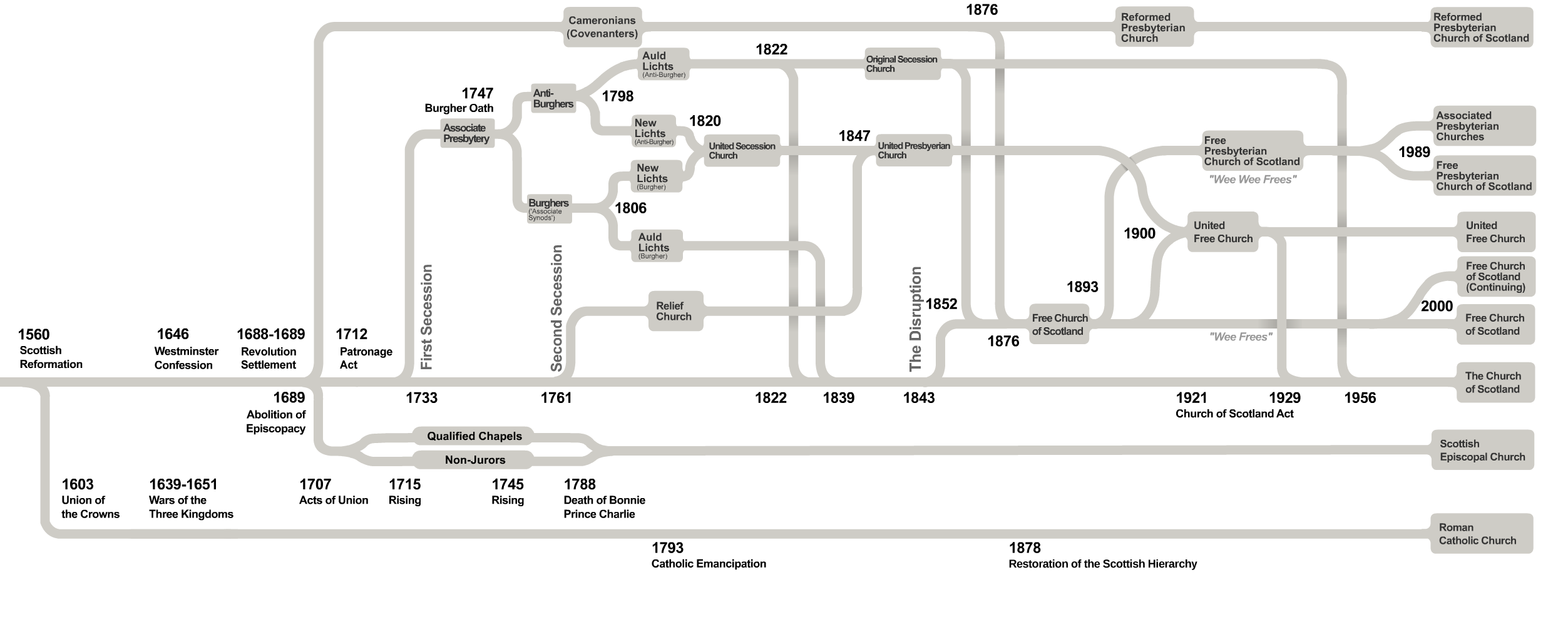
The next disruption in the Church of Scotland occurred with the Secession of 1733.  The issue here had to do with the concept of "patronage."  As the Wikipedia article just cited puts it, "The First Secession arose out of an Act of the General Assembly of 1732, which was passed despite the disapproval of the large majority of individual presbyteries. This restricted to Heritors and Elders the right of nominating Ministers to vacancies where the Patron had not nominated within six months."  Basically, patronage was a violation of the independence of the church from the state.  It allowed the state to set up rules for the appointing of ministers in churches without the agreement of the church or the church members, thus savoring of Erastianism.  As you can see from the Wikipedia article, a complex series of events developed from the General Assembly Act of 1732, which resulted in a separate church, known at first as the Associate Presbytery, being formed with the intention of continuing the true line of the Church of Scotland.  Later on in 1761, a second group broke off from the Church of Scotland, also over patronage, that called itself the Presbytery of Relief.  Both the first and second secession movements themselves split into further divisions, with the ultimate result that all of them ended up merging with other bodies eventually so that there is no Scottish church today that traces itself through that line, at least in any pure way, though there are churches today that exist from earlier mergers with secession churches.  The whole history of the secession movement, as well as of the various Scottish Presbyterian denominations in general, is very complicated and can be difficult to follow, as this chart makes clear.

I have mixed feelings with regard to the secession churches.  I agree with their stand against patronage (as does pretty much everyone else today), but I am not certain if the secessions were fully justified.  There are nuances here I feel a need to get a better grasp of before being more confident.  However, in a practical sense the question is moot, for all the churches that are in any way in the line of the secession churches existing today have by this time compromised their faith and practice to such a degree that they have forfeited their right to the de jure line, thus returning it, for practical purposes, to the continuing line of the established Church of Scotland in 1733.  The issue would be more pressing if there were secession churches existing today that were on par in terms of faithfulness with other existing Scottish Presbyterian churches.

I should also mention that it is around this time that we see the rise of the American Presbyterian tradition--the tradition that has led to the modern PCUSA as well as to more faithful Reformed denominations such as the Orthodox Presbyterian Church and the Presbyterian Church in America.  The first American presbytery came into being in 1706.  The American Presbyterian tradition illustrates the attitude of denominationalism that came to possess the church to a great degree.  The American presbyteries and synods never even tried to maintain formal communion with the Church of Scotland.  From the very beginning, they went their own way and did their own thing.  The American Presbyterian churches were formed from a mix of Scottish and Scotch-Irish immigrants and descendents who were more faithful to the traditions of the Church of Scotland and local New England congregationalists who were more loyal to the New England congregationalist tradition.  This resulted in a weakness in the full presbyterian-ness of American Presbyterianism.  At the beginning, they adopted no confession of faith at all, clearly neglecting the call to uniformity of the Solemn League and Covenant.  Shortly thereafter (due to pressure from the Scots and Scots-Irish), they received loosely the Westminster Confession.  In 1788, the American churches modified the Westminster Confession, bringing it in line with the latest American fashions in terms of disestablishmentarianism and denominationalism.  I do not consider the American Presbyterian churches ever to have had a claim to be in the line of de jure authority.

THE FREE CHURCH OF SCOTLAND AND THE FREE PRESBYTERIAN CHURCH OF SCOTLAND

The next significant disruption in the Church of Scotland, and the largest and most important by far in general, was the Disruption of 1843.  Once again, state interference in the church was at issue.  The Disruption split the church into two parties--the continuing established church and the Free Church of Scotland.  It is often difficult to weigh the decisions of those involved in these kinds of church splits, as the situation is often so complicated and sometimes there can be more than one right thing to do, or different ways of doing the right thing.  It could be argued that those who left the establishment in 1843 should have stayed and simply refused to comply with state interference with the church, which would have probably resulted in them being defrocked and perhaps even jailed one by one.  Instead, they chose to form themselves into a group and leave the establishment voluntarily (though not out of a desire to do so for its own sake) in order to continue the independent authority of the church.  From what I can see, I believe that their decision was justified, and all those on the side of truth ought to have followed them.  But even if we say they were being schismatic, the established Church of Scotland (which still exists today) has so departed from its biblical foundation as to certainly forfeit its claim to de jure authority, thus moving us over to the Free Church line anyway (unless sin is required to join with them, which I do not believe to be the case).

The Free Church of Scotland itself began a period of declension not long after the Disruption, leading eventually to a Declaratory Act being passed by the General Assembly which vitiated the constitutional commitment of the church to the Westminster Confession and required church officers to tolerate errors they had sworn to oppose.  This Declaratory Act was passed in 1892.  The Act compromised a number of the Calvinistic articles of the Confession as well as providing a general clause by which toleration was granted to disagreements with the Confession which "do not enter into the substance of the Reformed faith," this being left to be determined by the church courts on a case-by-case basis.  (See here and here for more on this.)  As a result of this, a number of ministers broke with the majority body to continue the true line of the Free Church in a separate organization which came to be called The Free Presbyterian Church of Scotland.  (See here for their Deed of Separation.)  I believe their split was justified, as the Declaratory Act had changed the constitution of the Free Church and required compliance from the officers of the church, which they could not give without compromising their integrity.

A number of people opposed to the Declaratory Act nevertheless stayed in the Free Church, hoping to bring reform eventually.  In 1900, however, the Free Church merged with the United Presbyterian Church, thus even further abandoning its historic principles, and a minority stayed outside this merger with the intent of continuing the true line of the Free Church of Scotland.  Due to winning a law suit, this minority group got to keep the name and thus to this day is called The Free Church of Scotland.  So after 1900, there were two groups which were very similar to each other, both of which had recently split from the larger body of the earlier Free Church of Scotland and claimed to be continuing its true line--The Free Presbyterian Church of Scotland and the Free Church of Scotland.  I believe that the Free Church ought not to have formed a separate organization when they broke off from the original Free Church, but they should have joined with the Free Presbyterian Church.  As the FP split in 1893 was legitimate, there was no need to start a new organization.  Thus, I regard the Free Church line as schismatic.

In the latter-half of the twentieth century, the Free Church began to fall into decline in some areas.  In 2000, due to what was claimed to be a botched discipline case illustrating the encroaches of liberalism in the Free Church, a group of ministers left the Free Church to form the Free Church of Scotland (Continuing).  The Free Church has further declined.  A couple of years ago, they began to allow uninspired hymns in worship, and there are other signs of increasing declension.  If the Free Church (Continuing) had not been formed, it would be easy to declare the Free Church line dead.  The FCC, however, is significantly more faithful, and in many ways very close to the Free Presbyterian Church (FPCS).

EXAMINING THE EXISTING ALTERNATIVES TO THE FPCS

Throughout the twentieth century, there were a couple of groups that split off from the FPCS or were formed partly in disagreement with them--namely, the Presbyterian Reformed Church (1931) and the Associated Presbyterian Churches (1989).  The former broke over disagreement with the FPCS's position that the use of public transportation on the Sabbath to attend worship constitutes a violation of the Sabbath.  The latter broke off in connection with disagreement over the FPCS's discipline of an elder for attending a Roman mass in his official capacity.

Another denomination recently formed that is very close to the historic Presbyterian position of the FPCS is the Westminster Presbyterian Church in the United States (2006).

Most of the existing denominations, including those calling themselves "Reformed," have removed far enough from the purity of the faith and practice of the historic Church of Scotland that it is clear they cannot claim the de jure line of legitimacy and authority, as officers would have every right to protest their constitutions and split from them, and purer denominations would be sinful to join with them.  There are only a few denominations existing today that are plausible candidates to be lawful heir to the historic Church of Scotland, from my point of view.  I would include among these the FPCS, the FCC, the Presbyterian Reformed Church (PRC), the Reformed Presbyterian Church of Scotland (RPCS), and the Westminster Presbyterian Church of the United States (WPCUS), all of which I've mentioned above.  All of them, I think, fail to present a greater claim to the proper de jure line than the FPCS.  Let's look at some of their reasons for separation from the FPCS, doctrinally and historically, and see why I think so.

The FCC is probably the closest of all to the FPCS.  They have the same doctrinal standards, and much of the same history and historical testimony.  I believe the FPCS has the better historical claim, in that it was formed earlier and had a right and duty to separate from the pre-1900 Free Church body.  As I mentioned earlier, I think the minority Free Church, from which the FCC is descended, ought to have joined the already-existing FPCS when they came into being and there was no good reason for them not to do so.  The FCC is a bit looser on certain aspects of church discipline than the FPCS, such as not enforcing the biblical command for women to wear head coverings in the church.  They are concerned that the FPCS is too strict and legalistic, but I'll come back to that in a moment.  Suffice it to say for now that I don't think the FPCS is too strict in any way that would require members or officers to sin, and so there is no legitimate justification for the FCC to continue separate from the FPCS, while the FPCS, I think, in addition to being the default because of its stronger historical claim, has reason to be concerned to join with a church that does not enforce something like the head coverings command.  It is possible that some of these differences in practice could be overcome, but whether or not that can happen, as the FPCS has the better historical claim, its overall claim to be the proper de jure line beats the FCC.

The PRC came into being, as I mentioned, because they disagreed with the FPCS disciplining members who use public transport to get to church on the Sabbath.  While I personally recognize some degree on nuance on that subject, and I'm sure the FPCS does as well (such as making room for necessity and mercy), yet I think the FPCS's position is within the realm of reasonableness in doing what they do.  Therefore, I do not think that disagreement with them on this point justifies a separate existence.  And so I think the PRC is schismatic.  (See this recent article by Matthew Vogan for some FPCS argumentation on this point.)

The RPCS seems similar to the FCC in that it is constitutionally just about identical to the FPCS, but it is a bit looser on discipline in some areas.  The RPCS comes from the Reformed Presbyterian heritage, which used to be Cameronian.  It is actually a minority remnant of the original RPCS which merged with the Free Church in the 1870s.  But in the twentieth and twenty-first centuries, it, too, like the earlier group, abandoned its historic commitment to Cameronianism (or at least it no longer pushes it very much) and to many of the reasons the RPs broke from the rest of the Church of Scotland in 1690.  Because of its earlier errors and the changes it has made (which, in themselves, are certainly changes for the better), the Revolution Settlement church line has a better historical claim, and as there is no doctrinal superiority the RPCS has over the FPCS, I regard the FPCS claim as stronger.

The WPCUS was formed to preserve a historic Presbyterian heritage in opposition to movement away from this in other American Presbyterian churches.  I do not believe that it has any viable doctrinal or practical justification to remain separate from the FPCS, and as it started in 2006, it certainly doesn't have a better historical claim than the FPCS.  Therefore, I consider it schismatic as well.

DEFENDING THE FPCS FROM CONCERNS ABOUT LEGALISM

The main concern other denominations express against the FPCS is that it is too strict and legalistic in some of its rules and discipline.  The Sabbath public transport issue is one example.  Here are a couple more examples:  1. Officers in the FPCS will tend to discipline women for wearing trousers.  This is in connection to Deuteronomy 22:5:  "The woman shall not wear that which pertaineth unto a man, neither shall a man put on a woman's garment: for all that do so are abomination unto the Lord thy God."  Many people, though not all, in the FPCS view trousers as men's clothing.  Is this legalistic?  Surely it is not legalistic to enforce God's commands.  But are trousers really men's clothing?  Well, historically they were.  Are they today?  Kind of, kind of not, depending on exactly who you talk to, when you talk to them, etc.  Although the principle that women should not wear men's clothing is a universal principle, what clothes constitute men's clothing is somewhat a culturally-determined phenomenon.  The FPCS realizes that, which is why they have not made any explicit written rule deciding what is and what is not men's clothing.  We need to look to the culture we are in to determine what is men's clothing in our cultural context.  Here in America, the cultural evaluation outside the church is ambiguous, as it is within much of the church.  But we must also take into account the internal culture of particular churches.  Certainly, within the FPCS, the culturally prevailing view is that trousers are men's clothing.  For women to wear them in that context, then, is to take the attitude of flouting Deuteronomy 22:5.  Whether or not we personally see trousers as men's clothing, I see no basis for considering the prevailing cultural attitude within the FPCS on this point today as constituting an intolerable, unjust legalism that justifies splitting the church.  You can find here the official statement from the FPCS Synod on women's and men's clothing, and here you can find a more full discussion of their position, including how it is typically applied to the trousers issue.

2. Another example is that the FPCS mandates the use of the King James Bible in its public worship services.  But surely it is the church's role to instruct people on how to read the Bible, and to provide them with guidance in terms of which translations are best and most trustworthy.  The FPCS holds that the manuscript tradition received by the church  historically should be considered the best tradition because it is the one God has preserved in the church over the centuries.  I think this is correct.  If the church, then, wishes to adopt an official translation to use in its worship services, in an effort to guide the church into the best translation and use of the Bible, I see nothing wrong with that.  Even if I thought the KJV wasn't the best version currently available, a point on which I currently have no strong opinions, disagreement on that point surely wouldn't justify splitting the church.  I should, in that case, simply work for change from within.

I could go over further examples of this sort of thing, and there are others that could be brought up, but I think they tend to fall into the same basic category:  The FPCS is more cautious and has a tighter discipline in certain areas than most other denominations today (in fact, its practice tends to be more historical on many of these matters), but I do not think that their discipline exceeds the reasonable limits of what the church is authorized to do, and I do not think that anything they do, even if we disagree with some aspects of it, constitutes sufficient justification for splitting the church, and therefore they do not shake the strong historical and doctrinal claim of the FPCS to be the proper heir to the de jure line of the church.

CONCLUSION

Therefore, on the basis of all of these things, I am currently of the opinion that the FPCS has the best claim to a de jure right to separate existence, and therefore it is the denomination all people ought to join, whenever it is practically possible to do so.  "Joining" them could mean becoming a member of the FPCS in the usual sense, or it could mean forming (or reforming) a church in another nation that is in full agreement and communion with the FPCS under a binding presbyterian international council.  Either way, we ought to be in full communion with the FPCS, and out of communion with other schismatic denominations, as much as we reasonably can, all things considered, without shirking other duties we may have.

UPDATE 6/16/14:  I have recently come across a nice, succinct statement discussing the Free Church of Scotland's position on the continuing obligation of the Solemn League and Covenant and on the Revolution Settlement, which argues that the Revolution Settlement church was the correct church to join in 1690 (in opposition to those who later became the Reformed Presbyterian Church of Scotland).  The article makes some great points in favor of tracing the de jure line through the Revolution Settlement church.

The article, among other useful references and links, provides a link to a publication by Alexander Shields, a covenanter minister who had reservations about the Revolution Settlement and associations with those who stayed outside the established Revolution church but who eventually decided to join with it, putting forward his arguments for joining the established church and not continuing in separation from it.  The article also provides a link to an article by Matthew Vogan in the Scottish Reformation Society Historical Journal on Alexander Shields.  Both articles provide further useful discussion of why the de jure line should be traced through the Revolution Settlement church.

UPDATE 11/10/14:  See here for more comments, from myself and from John Calvin, which relate to the charge of "legalism" sometimes made against the FPCS.  The church cannot add man-made traditions to the worship and service of God, but it has the right and duty to enforce biblical principles in light of its evaluations of how those principles ought to be applied in the context of current cultural attitudes and practices.

Why I Favor the Claim of the Free Presbyterian Church of Scotland . . .

. . . to be the proper de jure denomination to be a part of.  First of all, if you aren't familiar with my ideas on the nature of presbyterian church government and the meaning and implications of denominational separation, see here and here.  I will be assuming those ideas throughout this post.

WHY IT IS NECESSARY TO DISCUSS THIS

Because divided denominations (understanding a presbyterian system of church government) reject each others' de jure legitimacy and authority, it is necessary for us to examine the various denominations that exist to determine who truly has the right of separate existence.  If Denomination A and Denomination B are separate, and the separation is because Denomination A has introduced impurities into its worship (such as uninspired hymns) that officers in the church are not permitted to oppose, then Denomination B has a right and a duty to remain separated from Denomination A but not vice versa.  Denomination B is justified in rejecting Denomination A's de jure authority.  This implies a duty, all other things being equal, for all people to remain in formal communion with Denomination B but to leave formal communion with Denomination A.  Therefore, we cannot simply look around us and feel justified in being members of any fairly orthodox denomination we can find.  We must examine the historical and doctrinal reasons for separation, so far as these are accessible to us, and decide who has the better claim to de jure legitimacy, and then we have a moral obligation to join that denomination and no other.  To do otherwise, under normal circumstances (recognizing situations where practicality makes this difficult and even sometimes impossible), is to abet schism in the Body of Christ.

So let me lay out my reasons why I think the Free Presbyterian Church of Scotland (FPCS) is the right denomination to join.  I do not intend to go through each issue I will raise point by point and prove the validity of my position in each instance.  For example, part of my reasoning will include a commitment to exclusive psalmody.  I do not intend to provide an argument for exclusive psalmody in this post, but I will simply note my position on it and how it impacts my thinking on the topic under discussion.  I will do this with many other issues as well.  If I tried to prove everything I will claim in this article in this one post, it would quickly turn into a rather large book!  All I intend to do here is provide a basic, informal outline of why it is that I favor the FPCS's claim.  Also, I will focus on some issues and areas of history more than others in my outline.

I should add here that, at the present, I am very distant from the nearest FPCS congregation, and so am somewhat isolated (although I and my family are now adherent members of the church).  I have done a thorough study of the church, including a great deal of interpersonal interaction with lots of people (members, friends, and enemies), and I am convinced that my conclusions here are the best reading of the objective evidence.  Is it possible that I might find, in the future, that there is something about the FPCS which de-legitimates its claim to be the right denomination to join?  Certainly.  But, as of now, I have no reason to think that will turn out to be the case.  Human knowledge often has a certain tentativeness to it, particularly when it involves an examination of complex theological, philosophical, historical, and social matters.  And yet, having acknowledged that tentativeness, we often have good reason to go ahead and draw conclusions.  That is my position here.

THE EARLY CATHOLIC TRADITION THROUGH THE REFORMATION

I think it most helpful to approach this topic historically, because part of the claim to be the proper de jure denomination rests on historical factors.  Going back through church history, we start with the church of the apostles.  I am convinced that the early, mainstream catholic position is the rightful heir to the apostolic church--as opposed to, say, the gnostic heretics.  I'm not going to go into my reasoning here, but if you want to see a great case for this, I would highly recommend reading Irenaeus's book Against Heresies, especially starting in Book 3.  Iranaeus does a great job showing the historical and Scriptural pedigree of the catholic churches as contrasted with the horrible pedigree of the gnostics.

I also favor the catholic line in its rejection of various Trinitarian and Christological heresies that rose up in the early church--such as Arianism, Nestorianism, and Eutychianism--and in its rejection of Pelagianism.  In short, I favor the catholic faith of the church fathers.  I believe that faith is true, and the heresies that opposed it are false, and thus that the catholic churches maintained the proper de jure line during those early years (though not without some imperfections of their own, particularly as the centuries rolled along).

I find the eastern-western schism of 1054 difficult to evaluate.  I think that both sides were right and wrong about different things.  Certainly the eastern churches were right not to accept the growing power of the Roman papacy, but the eastern churches were also riddled with a strong semi-Pelagian theology, among other errors, while the western church better preserved Augustinianism.  As I consider the Augustinian as opposed to semi-Pelagian view to be central to the gospel itself, I take this very seriously.  On the whole, right now, my inclination is to go with the western church, in that it better preserved the gospel at that time, all things considered (though not necessarily hugely better).  Another possible way of looking at this is to say that as there were attempts to patch up the schism over the next few centuries after 1054, the schism wasn't fully completed until close to the time of the Reformation, after which time the issue of who was more right becomes moot for reasons we are about to address.

Note that being the proper de jure church for the time period does not at all necessarily imply that a church is anywhere close to perfection.  It is admitted on all hands that the late medieval western church was a huge mess in many ways, and yet I would still locate the line of de jure authority through that church during that time on the grounds that an alternative denomination had not yet been established to repudiate the Roman errors.  There were, certainly, small groups here and there that opposed the Roman errors, such as the Waldenses, the Hussites, the Lollards, etc.  But during the time between 1000 to 1500, these groups remained so relatively unestablished, scattered, small, and not always orthodox in every matter, that I do not count them as constituting a clear, world-wide alternative to the church in communion with Rome in the west (though I may count these groups as having de jure legitimacy along with the larger Roman church on a small scale and provincially).  When a church falls into constitutional error in such a way that officers cannot protest against it and avoid sin themselves by being complicit with it, those officers have a right and a duty, after pursuing first all ordinary channels of reform as much as reasonably possible, to leave the larger body and continue the true de jure church in separation from it.  However, until something like this happens, we should consider lawful authority to continue to reside with the existing body.  We see these procedural principles outlined in Matthew 18, for example, where Christ tells us to deal with problems in the church through formal channels of authority.  We do not have the authority to excommunicate people by ourselves as members, or even as individual officers.  We must pursue discipline through the proper courts of the church.  Only if this fails can we sometimes take extraordinary action, and until such action is formally taken, we cannot act as if the deed has already been done.

I certainly believe that the Protestant Reformation was justified in its break from Rome.  Rome was given hundreds of years to reform, and it refused to do so.  I consider the full break to have occurred at the time of the Roman Council of Trent.  After this time, I trace the de jure line of the church through the Reformation churches rather than through Rome (or through the eastern churches).

THE REFORMATION AND THE REFORMED TRADITION

There are various branches of the Reformation.  I favor the line of the magisterial Reformation of Luther, Calvin, and Zwingli over the Anabaptists and other sectarian groups.  The Zwinglians and the Calvinists were able to come to agreement and unite in a unified Reformed faith, but the Lutherans and the Reformed were never able to come to full unity.  The distance between them only grew wider over time.  I would probably place the final Lutheran and Reformed division somewhere in the latter-half of the sixteenth century (at the point where it became clear the two groups were going to continue to go their separate ways), and I favor the Reformed side of the split.  The Lutherans were compromised on the regulative principle of worship as well as on central features of predestination and salvation by grace, among other issues.

From the middle of the sixteenth century until about 1690, I think of all the Reformed churches as being basically united.  Certainly, during this time, differences were emerging, such as the solidification of the practice of celebrating extra-biblical holidays in the continental Reformed churches, but things were still fluid enough that I don't count any finalized breaks until the end of the seventeenth century.  The Church of England, as well, was in flux during this time.  It never reformed to the degree of the continental or Scottish churches, but there were ongoing attempts to reform it.  The ongoing attempts to preserve unity with all the Reformed churches as well as with the Church of England are exemplified, I think, by the Synod of Dordt, which maintained an international character (at least in terms of its condemnation of Arminianism), and by the Second Reformation period in Britain.  There were delegates from many national Reformed churches at Dordt.  During the Second Reformation period, there was an attempt to reform the Church of England to bring it in line with Scotland and other Reformed churches, and there were attempts to preserve bridges with the continental churches as well.

However, things changed at the end of the seventeenth century.  The latter-half of the seventeenth century saw the rise of the popularity of the idea of toleration.  For really the first time, it began to be conceivable to Europeans that nations might allow multiple competing churches to exist together.  At this point, also, the idea first begins to enter the church that multiple churches could exist side by side in the same nation.  In short, the end of the seventeenth century saw the rise of the idea of multiple disestablished denominations existing together in the same nation.  Before this time, such a thing was nearly literally unthinkable to most people.  I call the period from 1517 to 1690 the Age of Reformation, and I call the period from 1690 to the present the Age of Denominationalism.  When William of Orange took over Britain, he restored Presbyterianism to Scotland, but preserved Episcopalianism in England.  At this point, I think we see a change in practical attitudes towards the unity of the church.  The Church of Scotland, for example, is no longer as active in attempting to promote an international Presbyterianism among all the Reformed churches.  Instead, she turns inward and begins to deal more and more with internal disagreements and divisions.  In 1690, the Reformed Presbyterians split off from the Revolution Settlement Church of Scotland, creating the first split in the Scottish Presbyterian ranks to last down to the present day.  From 1690 on, instead of an international Reformed movement, we see all the national Reformed churches split into more and more rival sects, to the point where the idea of multiple denominations to choose from has become a natural part of our environment.

I think of 1690, with the Revolution Settlement in Britain, as being the time when the continental churches and the Church of England can be considered to be fully separated from the Church of Scotland, because after this time there is no real attempt to bring unity in practice between the different groups and thus no possibility for the groups to be in full communion.  I favor the Church of Scotland over the others, and consider it to have preserved from that time on the true de jure line of legitimacy and authority.  The continental churches have remained very close to the Scottish tradition, but they have come to tolerate and even to enforce the practice of churches observing extra-biblical holy days--such as Easter and Christmas--as a part of the ongoing worship of the church.  I believe that this is a violation of the regulative principle of worship.  I agree, rather, with the Scottish position on extra-biblical holy days, as expressed in the Westminster Directory for Public Worship:  "THERE is no day commanded in scripture to be kept holy under the gospel but the Lord's day, which is the Christian Sabbath.  Festival days, vulgarly called Holy-days, having no warrant in the word of God, are not to be continued.  Nevertheless, it is lawful and necessary, upon special emergent occasions, to separate a day or days for publick fasting or thanksgiving, as the several eminent and extraordinary dispensations of God's providence shall administer cause and opportunity to his people."  Of course, anyone may focus on the birth of Christ on December 25, etc., if he so wishes, but we are not free to view the observance of such holy days as a required and necessary thing--in other words, as part of the prescribed worship of the church--nor are we free to enforce these festivals on others (as is done when they are made a part of the church's corporate worship and life).  The Church of England has maintained many more extra-biblical traditions in its practices.  So our focus from here on out narrows to the history of the Church of Scotland from 1690 onwards.

To be continued in Part II . . .

Monday, April 15, 2013

The One Church in Its Different Aspects

The one church can be viewed in different ways, and it is helpful in order to gain a full-orbed understanding of it to consider it in these different ways.

The Invisible Church:  This is the church, the Body of Christ, as it is viewed by God.  It is called invisible because this view of the church is not accessible to the limited perspective of human beings.  God sees the church throughout all time and space, and he sees beyond the pretenses of a false profession of faith, knowing whose faith is (or will be) genuine and whose is not.  The Westminster Confession sums it up in this way:  "The catholic or universal Church, which is invisible, consists of the whole number of the elect, that have been, are, or shall be gathered into one, under Christ the Head thereof, and is the spouse, the body, the fulness of Him that filleth all in all."

The Visible Church:  This is the church as it appears to man.  We human beings are bound to time and space, and cannot see into the hearts of men (other than our own).  As we look around us, we see various evidences of the presence of Christianity, of the work of the Spirit, of a Christian attitude and profession, of the existence of the Body of Christ, in various places, groups, and individuals.  But we can never be sure (outside of ourselves) that those who are making what appears to us to be a credible profession of faith and obedience are really doing so from the heart.  There are many who profess Christ but who are not truly sincere in the deepest sense (think of the parable of the sower), some of whom visibly fall away from the faith eventually.  The best we can do is examine the professions that people have made, watch for glaring inconsistencies, and employ a judgment of charity to accept as brothers and sisters all those whom such charity allows us to accept.  The Westminster Confession describes the visible church in this way:  "The visible Church, which is also catholic or universal under the gospel (not confined to one nation as before under the law), consists of all those throughout the world that profess the true religion; and of their children: and is the kingdom of the Lord Jesus Christ, the house and family of God, out of which there is no ordinary possibility of salvation."

Of course, it is the visible church which is the practical form of the church, in that all our dealings in this world with our brothers and sisters in Christ are dependent upon things as they appear to us.  It is in the visible church that we find the fellowship of the saints, as well as the "ministry, oracles, and ordinances of God," as the Confession puts it.

Within the concept of the visible church, there are two categories:

The Visible Church De Facto:  This refers to an informal evaluation of the presence of the church from the perspective of people, or Christians, in general--that is, it is the church viewed in terms simply of its being in the world as opposed to any question of formal legitimacy or (ecclesiastical) legality.  For example, I observe that my neighbor makes a profession of the true religion.  I am aware of nothing in his life that clearly contradicts such a profession, and so, in the exercise of a judgment of charity, I accept him as my brother in Christ.  A sincere Christian profession, so far as I can see, is consistent with a degree of error and inconsistency.  Perhaps my neighbor, for example, is a baptist.  I consider him wrong not to baptize his children, but I have no conclusive reason to think he has taken that position out of malice against God and his truth rather than out of a more excusable confusion or ignorance, and so I do not cease to regard him as a brother.  On the other hand, if he were living in such a way that the Bible makes clear cannot consist with a regenerated heart, I could not regard his profession as credible.

Similarly, we look around us and we see the communal aspects of the Body of Christ manifested in varying ways and to various degrees.  For example, perhaps my neighbor participates in a small  house church.  There is no formal membership, but there are clearly one or two individuals who function as the teachers of the group, and other spiritual gifts appear to be manifested.  I can regard this, so far as I can judge, as a manifestation of the Body of Christ in the world, even if I think it imperfect in various ways.  I also look around me and see many other denominations and groups of Christians who, more or less, seem to be manifesting the existence of the church and the doctrines and practices of Christianity.

The Visible Church De Jure:  This refer to the church as judged and evaluated from the formal perspective of the legitimate office-bearers and courts of the church in their formal capacity--that is, it is the church viewed according to the rules of formal legality and legitimacy.  Christ has given the keys of governance to the legitimate officers and courts of the church.  It is their job to constitute the church's formal and legal presence in the world, providing a concrete foundation around which the members of the church are to gather, dispensing the sacraments, teaching the Word of God, etc.  It is their job to formally welcome individuals into the church, to dispense church privileges (such as baptism and the Lord's Supper) to members, to exercise spiritual oversight and discipline over them, to formally excommunicate those who need to be cut off from the body, etc.

The legitimate office-bearers and courts of the church have the duty of formally recognizing who the members of the church are, as well as who the officers of the church are.  Officers recognize each other by joining into formal church courts--such as church-sessions, presbyteries, national councils, and ecumenical councils.  They recognize members by keeping a formal roll of members over whom they are pledged to exercise spiritual authority (and we might distinguish between members who are in partial communion and those who are in full communion with the church).  Church members formally recognize these officer-bearers and courts, agreeing to submit to them, and they recognize formally the rest of the body by participating with them in public worship, the sacraments, and the other functions of the church.

On the de jure level, more scrutiny is required of those who would be counted as members and leaders of the church.  On the de facto level, anyone who, in the providence of God, is actually exercising a gift of teaching, for example, is exercising a gift of teaching and so is a teacher in the church whom God may choose to use in that capacity.  On the formal de jure level, however, there ought to be clearer formal rules regarding whom should be admitted into the role of teacher in the church, and the exercise of such an office needs to be formally recognized by those who have the authority to recognize it.  A person cannot simply stand up and declare himself to be a formal teacher in the church without being examined and approved by the leaders of the church.  Likewise, on a de facto level, I may regard with a judgment of charity my neighbor who appears, so far as I can tell, to have a credible profession of faith.  However, church officers and courts must be more careful in admitting members formally into communion with the church and to the privileges of church membership.  In my view, for example, while a baptist may be a true Christian and thus regarded as such by a judgment of charity on the de facto level, a baptist ought not ordinarily to be admitted to formal full communion in the church, on the grounds that his refusal to baptize his children is in violation of the command of God that children are to be treated as insiders in the covenant community.  The church cannot judge his motives, whether he be innocent (more or less) in his error; they must require him to conform to the commands of Christ and treat him accordingly if he does not.  (There are certainly nuances here that could be better brought out if this was the time and place to do so.)  On a de facto level, I may hope and assume that his motives are relatively pure, but the church acting formally must not connive at the outward action of refusing to comply to a command of Christ.

The unity of the church on a de facto level transcends denominational barriers.  However, the unity of the church on the formal, de jure level is limited by those barriers.  The officers and courts of each denomination have conflicting views of the de jure church.  They have a different set of recognized officer-bearers and church courts, and they do not recognize each others' authority.  They have a different roll of members.  The members of different denominations have a commitment to submit to different officers and courts, and their formal communion with each other is limited by their denominational affiliation.  In order to ascertain the correct de jure view of the church, we have to ascertain which are the legitimate officers and courts of the church, but this is precisely where agreement is lacking between denominations.  Members and officers of the Orthodox Presbyterian Church, for example, have a different set of officers and courts that are treated as authoritative than do members and officers in the Free Presbyterian Church of Scotland.  The views are incompatible, since the denominations are not in formal full communion with each other.  Coming to view the church from the proper formal de jure perspective, therefore, requires that we ascertain which denomination actually possesses the authority they all claim.  And then we must look at the church from the formal perspective of that denomination.  My current position is that the proper denomination from which to view the formal de jure existence of the church is the Free Presbyterian Church of Scotland.  See here for more details on the basis of this claim.

More discussion of the issues raised in this article can be found here, as well as in my ongoing series on church authority, church unity, and presbyterian church government (which mostly overlap with each other).